
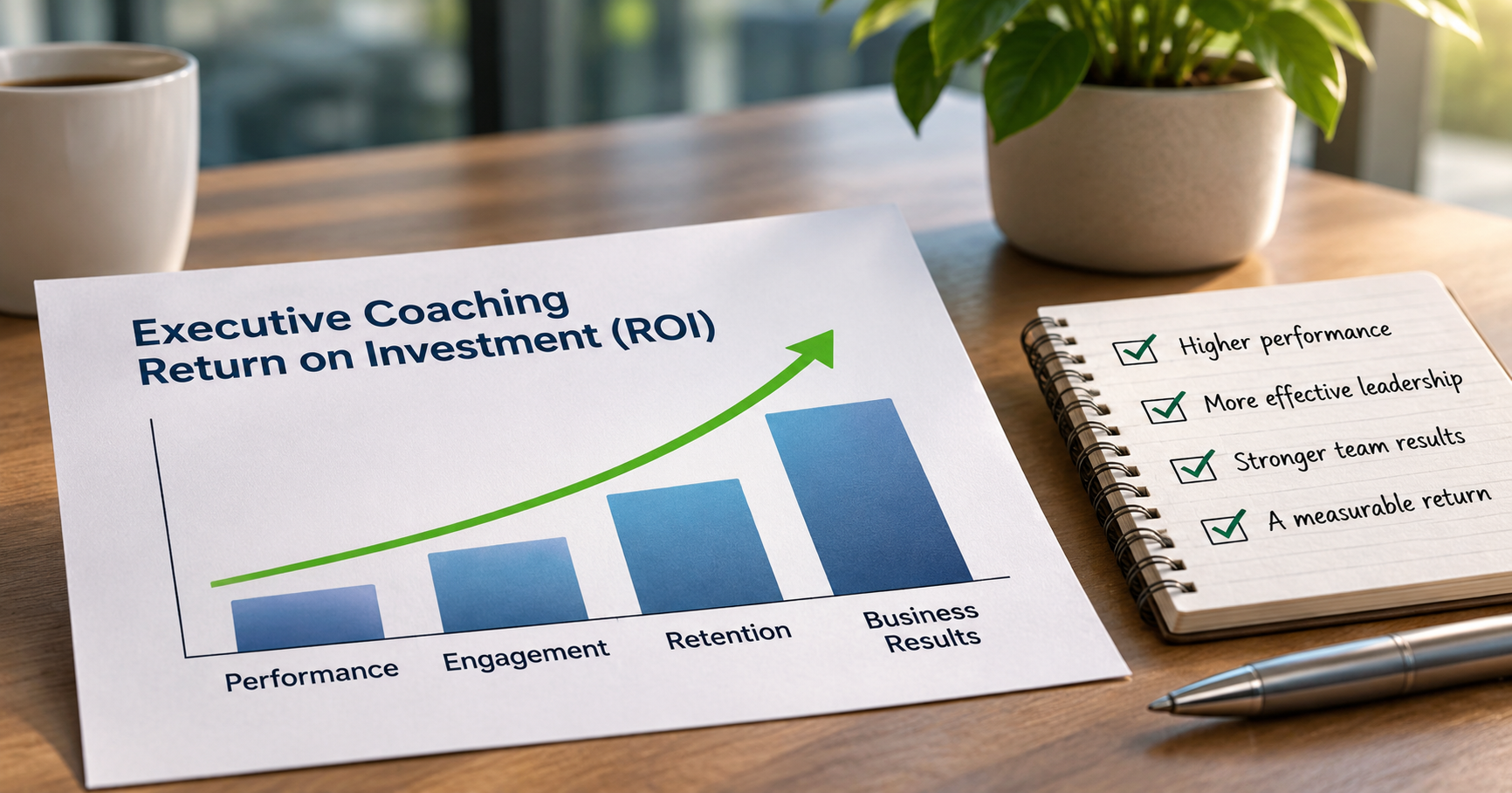
Executive coaching has a growing research base, including studies that compare coached participants with control groups. On average, those studies find positive effects on a range of work-related and personal outcomes. It's encouraging, but the evidence doesn't establish that every coaching engagement works, that every improvement is caused by coaching, or that a particular financial return is guaranteed.
An engineering director is struggling to lead through their managers. Decisions keep escalating, difficult conversations are delayed, and the director is constantly pulled into technical meetings that they shouldn't be part of.
Their organization is considering a six-month executive coaching engagement. The proposed investment is significant, and a reasonable question follows: Does executive coaching actually work?
For an engineer, there's a familiar way to approach that question. Look at the evidence, understand what was measured, and decide what conclusions the findings can support.
Executive coaching deserves the same scrutiny as any other professional service.
What does the research say overall?
The short answer is that research reviews generally find positive average effects from workplace coaching, although the estimated size of those effects varies and the studies do not all measure the same outcomes.
A 2014 meta-analysis by Theeboom, Beersma and van Vianen combined 18 studies involving 2,090 participants. The researchers examined performance and skills, well-being, coping, work attitudes, and goal-directed self-regulation. They reported positive average effects across all five categories, although the size of the effects varied.[1]
A 2016 meta-analysis by Jones, Woods and Guillaume examined 17 studies of workplace coaching delivered by internal or external coaches. It found an overall positive effect on learning and performance-related outcomes. The authors also noted that different study designs and outcome measures complicate the interpretation of results.[2]
More recently, de Haan and Nilsson published a 2023 meta-analysis based exclusively on randomized controlled trials. Their review identified 37 studies, with 36 contributing usable data from 39 independent samples involving 2,528 participants. They estimated an overall effect of g = 0.59, generally described as a moderate standardized effect. After adjusting for possible publication bias, the estimated effect decreased to g = 0.32 but remained positive and statistically significant.[3]
A separate 2023 meta-analysis by Cannon-Bowers and colleagues also reported positive effects of workplace coaching while arguing that the field still needs stronger studies and better descriptions of what actually happens during coaching.[4]
Taken together, these studies provide reasonable grounds to regard coaching as a potentially useful development intervention. They do not tell us that every coaching model, coach or client will produce the same result.
What do those results actually mean?
Research papers commonly report an effect size. It measures the difference associated with an intervention in standardized terms so that results from different studies can be compared or combined.
It is easy to misread an effect size. A reported effect of g = 0.59 does not mean coaching improved leadership by 59%, raised productivity by 59%, or generated a 59% return on investment.
It describes an average difference between groups in the outcomes included in the analysis. Those outcomes might include self-reported confidence, goal attainment, observed behaviour, or assessments of performance. They are related, but they are not interchangeable.
A technical leader might feel more confident making decisions after coaching. Although this is useful, it's different from demonstrating that project delivery improved or that the organization reduced avoidable escalations.
The central question for a buyer is therefore more specific than whether coaching works in general: Which outcomes are likely to matter in my situation, and how will we know whether they changed?
What outcomes are supported by research?
The studies cover a wide range of outcomes. For an engineering or manufacturing organization, three categories are particularly relevant.
Leadership behaviour and practical skills
Coaching can help leaders examine how they delegate, handle conflict and respond to difficult decisions. Some studies look at reported changes in behaviour or leadership capability; others use feedback collected from people around the leader.
For example, a director might learn to stop answering routine technical questions and instead ask their managers to recommend something. The relevant outcome is whether managers begin making appropriate decisions with fewer unnecessary escalations.
The research supports the possibility of improvement in leadership-related behaviour, but any specific engagement still needs to show that the desired behaviour changed. A good coaching conversation is not evidence on its own.
Goal-directed action and self-regulation
Coaching involves creating goals, identifying unhelpful habits, testing responses and reviewing the results. Theeboom and colleagues found positive effects in goal-directed self-regulation, a category particularly relevant to this kind of development work.[1]
Consider a plant manager who repeatedly postpones difficult performance conversations. Coaching may help them recognize the pattern, prepare for the conversations and follow through. Progress would show up in timely action and clearer expectations, rather than in the manager's intentions.
Well-being and coping
Research also reports improvements in well-being and coping with work-related challenges. These are meaningful outcomes, particularly for leaders facing sustained pressure, but they should not be confused with treatment for a medical or psychological condition.
Coaching can help a leader to examine their priorities, boundaries and responses to pressure. It cannot, by itself, resolve chronic understaffing, an unsafe work environment or poorly designed organizational responsibilities.
How strong is the evidence?
The research is promising. It is also less definitive than some marketing claims suggest.
First, not all studies use strong comparison groups. If a leader reports improvement after coaching, other factors may have contributed. A new manager, organizational restructuring, a change in workload or ordinary experience in the role might also explain part of the difference.
Randomized controlled trials help address that problem by comparing groups assigned to different conditions. These studies are valuable, although they still differ in the type of coaching provided, who participates and what is measured.
Second, self-reported improvement can be larger than externally observed improvement. De Haan and Nilsson reported stronger effects for self-reported outcomes than for outcomes observed by others.[3] Feeling more capable matters, but organizations should be careful about treating it as proof that team performance improved.
Third, publication bias and variation between studies matter. Researchers are more likely to find and include published studies, and studies with positive findings may be more likely to be published. Different interventions may also be grouped together under the broad label of coaching. A 2023 review highlighted how inconsistent reporting of coaching activities and settings still makes it difficult to determine precisely which elements produce results.[4]
These limitations are important to consider, but the research still finds positive average effects from workplace coaching.
Can coaching produce a measurable return on investment?
Sometimes. But there's a large difference between demonstrating a useful business outcome and proving that coaching caused a particular dollar return.
Suppose a company spends $15,000 on a coaching engagement for an engineering director. Six months later, projects are moving more smoothly, managers report greater decision authority, and the director spends more time on strategic priorities.
Those are encouraging results. Translating them into a credible financial return requires additional work.
Were project delays actually reduced? What was the cost of those delays? How much of the improvement can reasonably be attributed to coaching rather than staffing changes, new processes or other initiatives? Was the financial estimate based on recorded costs or participants' perceptions?
There's nothing wrong with estimating business value when the assumptions are transparent. The problem arises when a highly specific ROI percentage is presented without a defensible method or comparison.
For some leadership goals, observable behaviour and stakeholder feedback will provide a more honest assessment than a dollar figure. For others, relevant operating measures may be available.
How should technical organizations evaluate coaching?
The best time to decide how progress will be assessed is before the engagement begins.
Start with a small number of concrete outcomes connected to the leader's responsibilities. Avoid setting broad objectives such as “be a more effective leader” without specifying what that would look like at work.
For example:
Delegation and accountability: Are routine decisions being made at the appropriate level? Have unnecessary escalations decreased while safety and quality controls remain intact?
Communication and relationships: Are difficult conversations happening earlier? Do colleagues report clearer expectations and more constructive collaboration?
Strategic leadership: Is the leader making progress on longer-term priorities rather than repeatedly intervening in issues that do not require their involvement?
Depending on the goals, evidence may come from the leader's observations, stakeholder feedback through a 360-degree assessment, or relevant business metrics. Recording where things stood before coaching began also makes it easier to measure what has changed.
Midpoint and closing reviews can then examine what changed, what remains difficult and what else happened in the organization during the same period.
For employer-sponsored coaching, these reviews require a clear confidentiality agreement. Sponsors can review the development goals and the evidence of progress, provided what's shared has been agreed upon in advance, without receiving private session notes or unrestricted access to coaching conversations. The ICF Code of Ethics establishes expectations for agreements and confidentiality among the parties involved.[5]
What makes a coaching engagement useful?
Research can identify patterns across groups, but the evidence does not justify a simple formula that guarantees success. There are, however, conditions to establish before making the investment.
The first is a clear reason for coaching. A leader who wants to improve delegation, stakeholder influence or their transition into a larger role has a better starting point than someone who's been told to attend coaching.
The second is an appropriate relationship with a qualified coach. The leader should be able to speak openly, examine uncomfortable assumptions and work with someone who understands the boundaries of the coaching role. Technical experience may improve contextual understanding, but it does not replace professional coaching skills.
The third is an environment that permits the leader to act. A manager cannot delegate decisions that organizational policy reserves for their boss. If unclear decision rights or conflicting incentives are the main problem, the organization will need to change its systems alongside any coaching investment.
One qualification is worth stressing: research has not established a universally optimal number of sessions or a single best delivery format. The 2016 meta-analysis did not find a consistent moderating effect for coaching format or duration in the studies it reviewed.[2] An engagement should be designed around its purpose and reviewed as it progresses, rather than sold on the assumption that more sessions automatically produce better results.
What does this mean for an engineering leader?
Return to the director whose managers escalate too many decisions.
Coaching can help the director recognize how their involvement in technical discussions has taught managers to wait for approval, and why they struggle to accept decisions that are imperfect but reasonable.
The director might agree on clearer escalation thresholds, ask for recommendations rather than taking over, and review the consequences of these changes over several months.
If managers begin exercising appropriate judgment and the director has more capacity for strategic leadership, the engagement is producing observable value.
But if an approval policy still requires every decision to reach the director, coaching alone is unlikely to solve the problem. That is a systems issue, and the organization needs to address it directly.
This distinction is important. A good coaching engagement should help identify what the leader can change, while remaining realistic about problems outside the leader's control.
So, does executive coaching work?
Yes, there is credible research showing that workplace coaching, including executive coaching, can improve a range of individual and leadership-related outcomes on average. The evidence is not a guarantee of success for an individual engagement, and claims about business impact should be proportionate to what was actually measured.
For engineering and technical leaders, it suggests a practical approach: define the problem, select the right kind of support, agree on observable outcomes, and evaluate what changes in everyday work.
The most convincing evidence of value is a leader making better decisions, developing stronger managers and contributing more effectively to the organization. Research supports taking coaching seriously. The results of a specific engagement still need to be demonstrated.
If you want to understand the process behind a typical engagement, see How Does Executive Coaching Work? What to Expect from a Coaching Engagement. For help deciding whether coaching, mentoring, training or consulting fits your situation, see Executive Coaching vs. Mentoring, Training and Consulting.
To explore coaching for yourself or leaders in your organization, visit Will Ferry Group's executive leadership coaching.

Dr. Will Ferry
PhD, P.Eng., ICF-ACC, CPCC
Dr. Will Ferry is the founder of Will Ferry Group and an executive coach, facilitator, and fractional engineering executive. He partners with industrial and high-tech companies to build stronger leaders and teams as they navigate growth and change.
Connect With Will