
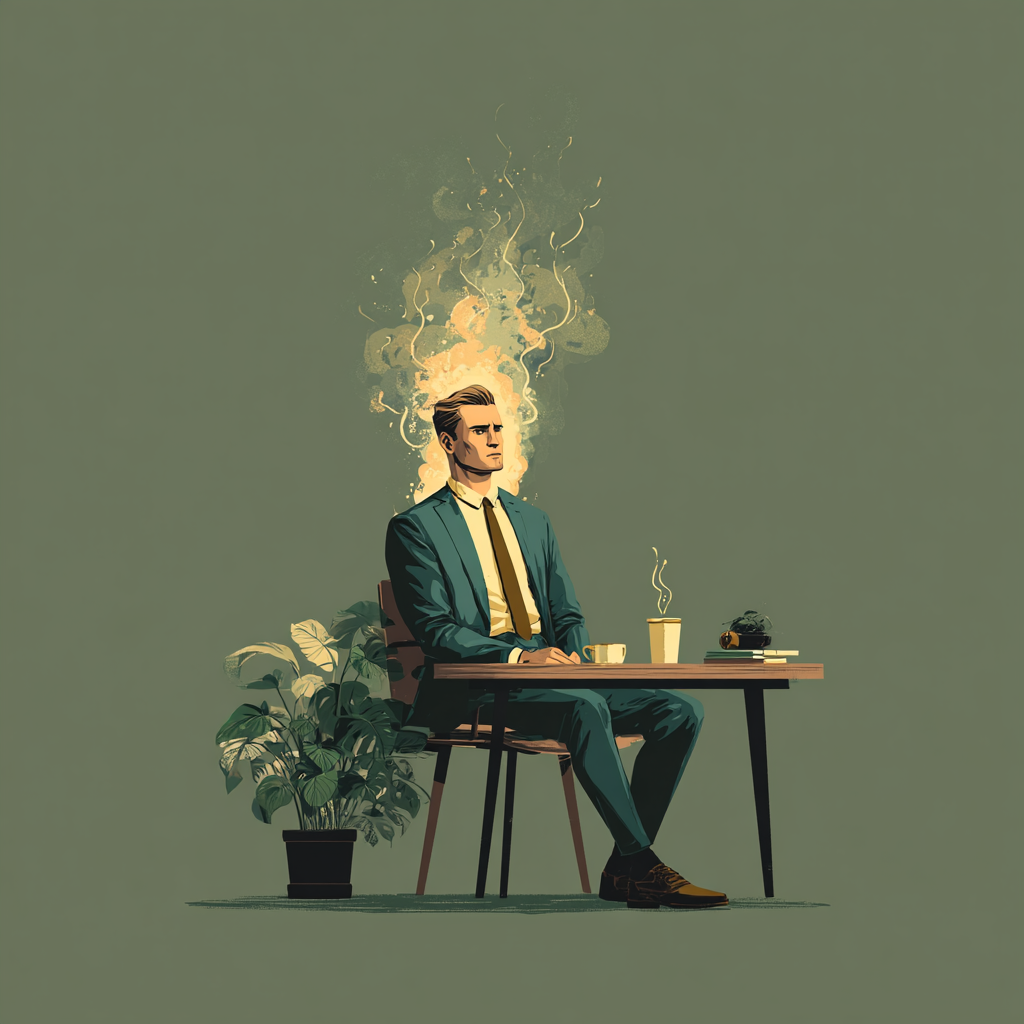
Burnout's become a word that means almost anything these days.
People use it to describe a hard week, a bad manager or genuine, months-in-the-making exhaustion that's changing how they think about their whole career.
This looseness in definition can lead to the wrong interventions, since "take a vacation" and "you need a completely different relationship with your work" aren't interchangeable solutions.
Treating the second problem with the first solution is one reason why people return from time off feeling almost as burned out as when they left.
Here's what the research says and where I think the conversation falls short.
The standard definition
The World Health Organization's ICD-11 classifies burnout as an occupational phenomenon resulting from chronic workplace stress that hasn't been successfully managed.[1] It's deliberately not classified as a medical diagnosis, which matters more than at first glance (more on that below).
The framework identifies three dimensions:
Exhaustion: persistent feelings of energy depletion that aren't fully resolved by rest or a brief break from work.
Cynicism, or mental distance: growing negativity, detachment, or emotional distance from the work. The work may no longer feel as meaningful or worth caring about as it once did.
Reduced professional efficacy: a declining sense of competence and accomplishment, often without any decline in output.[1] I believe that this is the part most people miss. It's the one that lets high performers produce while quietly losing the connection to what they're producing.
One of these by itself doesn't necessarily mean someone is burned out. A person may be exhausted but still engaged in their work. They may feel cynical because their values no longer align with the organization, but still having plenty of energy. They may doubt their effectiveness during a difficult transition without experiencing either exhaustion or detachment.
Burnout becomes more common when these patterns begin appearing together and persist over time.
Different models ask different questions
The three-dimensional framework isn't the only lens used by researchers. Other models ask different and equally important questions.
Instead of asking, “Is burnout present?” they ask, “What conditions are causing it?”
Here are some of the more well-known ones:
Maslach and Leiter's Areas of Worklife model [2] identifies six common areas of mismatch between a person and their work:
Workload
Control
Reward
Community
Fairness
Values.
Workload tends to receive the most attention because it's easy to see and measure. Control is often not as visible, but a lack of it can contribute to burnout and create problems in other parts of an employee's job.
Two people can carry similar workloads and end up in completely different places. One employee may have substantial influence over how, when, and why the work gets done. The other may have little say over their priorities, methods, or expectations.
The amount of work matters, but so does the experience of being unable to influence it.
I suspect that lack of control is responsible for more burnout than many organizations fully recognize.
The Job Demands-Resources (JD-R) model frames burnout as an imbalance between what the work requires and what someone has available to meet those requirements[3] .
Job demands can include workload, emotional pressure, role ambiguity, difficult relationships, and constant interruptions.
Resources can include autonomy, support, useful feedback, clear expectations, opportunities for growth, and adequate time and tools.
High demands are more likely to result in burnout when the resources available to meet them are insufficient. Resources can reduce the strain of demanding work, but they don't make unlimited demands sustainable. [4]
This moves the conversation away from simply asking:
“How much are you working?”
towards a better question:
“How much is being demanded of you relative to the resources, support, and recovery available to you?”
This is a much more useful question, but a harder one to answer honestly.
Conservation of Resources (COR) theory helps explain why burnout often compounds rather than levels off [5].
People experience stress when they lose important resources such as time, energy, confidence, status, support, or a sense of control. As those resources are depleted, they have fewer resources available to protect themselves from further losses.
Someone who's exhausted may withdraw from relationships. That isolation removes a source of support. They may then perform less confidently, which affects their sense of competence. They may work longer to compensate, leaving them with even less time to recover.
Loss creates further loss[6] and helps explain why burnout can appear sudden from the outside.
Someone may seem fine until they aren’t. In reality, the process may have been gradual and gone largely unnoticed, but quietly accelerating for months.
The Copenhagen Burnout Inventory [7] separates burnout according to its source:
Personal burnout
Work-related burnout
Client-related burnout
The distinction is useful because not every form of exhaustion comes from the same place.
Someone may be depleted across most areas of life. Another person may feel reasonably good outside work but become exhausted whenever they think about their job. Someone in a caregiving or client-facing role may find that working directly with patients, clients, or customers is the most exhausting part of the job.
What will help depends on where the depletion is coming from.
The debate the field hasn't settled
Researchers continue to debate how clearly burnout can be distinguished from depression.[8][9]
The WHO's choice to classify it as occupational, rather than a medical condition helps distinguish the two, but it doesn't fully resolve the debate.
My own view is that burnout can be a useful description when the symptoms are predominantly tied to a particular job, role, or working environment. Someone can still feel engaged with family, friendships, hobbies, and other parts of life while feeling depleted and detached at work.
But that distinction should never be used to rule out depression.
Burnout and depression can overlap. A person can experience both at the same time, and prolonged occupational burnout can begin affecting areas of life far beyond work.
When the symptoms become severe, pervasive and significantly interfere with everyday functioning, coaching should not be a substitute for support from a qualified healthcare professional.
At that point, the person may need clinical support, not a better delegation framework.
Turning the research into a practical recovery map
These models help explain burnout, but they don't automatically tell an individual where to begin.
In practice, I find it helpful to translate the research into five areas for assessment. These are not five additional diagnostic criteria. They're a practical way of identifying both the conditions that may be causing the problem and the resources that may need rebuilding.
Health.
Physical symptoms are often the earliest signals that something is wrong.
Disrupted sleep, persistent fatigue, muscle tension, headaches, digestive problems, and difficulty concentrating may show up well before someone identifies as burned out.
Sleep deserves particular attention. Poor sleep can be both a consequence of workplace stress and a contributor to further exhaustion, reduced emotional regulation, and impaired decision-making.
Rest alone may not solve burnout, but recovery is extremely difficult without it.
Nutrition.
Nutrition won't solve a poorly designed job or an unhealthy workplace.
However, irregular eating, skipped meals, and heavy reliance on caffeine or energy drinks can make concentration, sleep, and recovery more difficult.
Under pressure, people often remove the routines and discipline that help them function exactly when they need those routines most.
These habits may not be the root cause of burnout, but they can accelerate the downward spiral.
Relationships.
Isolation tends to make burnout worse.
Connection is especially helpful when someone has people they can be honest with about difficult personal challenges, without worrying that what they're saying could hurt their career or change how they're seen at work.
This connection can come from colleagues, friends, family, a manager, a mentor, a coach, or a professional community outside the organization.
The important question to ask is whether they have somewhere they can speak honestly, receive perspective, and ask for help.
Purpose and perspective.
Two related questions tend to appear here:
“Does this work still matter to me?”
And:
“Do I believe anything about this situation can change?”
The first is about meaning, values, and fulfilment. The second is about agency and perspective.
Someone may still care deeply about their work but feel trapped by the conditions under which they're doing it. Another person may have a lot of freedom but no longer believe the work is worth doing.
Purpose and perspective can reinforce each other. When work loses its meaning, people become less willing to challenge the conditions around it. When their circumstances feel fixed and unchangeable, it becomes harder for them to remain connected to the purpose.
Recovery may involve reconnecting with why the work matters. It could also involve admitting that it no longer does.
Control and autonomy.
Control comes directly from the Areas of Worklife model and deserves more attention than it receives.
Workload is usually the most visible complaint. But the deeper problem may be having little control over how the work gets done.
People struggle when:
Priorities keep changing without their input
Decisions that affect their work are made without them
Expectations are unclear
They're held accountable for outcomes they had little or no say in
Not everyone has the power to redesign their job. But it's still worth looking for areas where they can have more influence.
That might mean clarifying expectations, resetting priorities, or addressing a problem that's been tolerated for too long.
Sometimes meaningful change requires support from a manager or the wider organization. Sometimes it requires changing roles. But the first step is recognizing that the problem is not always the amount of work. It may be having too little influence over it.
Where this leaves you
The three established burnout dimensions:
Exhaustion
Cynicism
Reduced professional efficacy
can help you determine whether you may be experiencing something more serious than being a bit tired.
The next question is: what's is driving it?
Is the main problem workload, lack of control, inadequate support, unfairness, conflicting values, depleted health, or the loss of meaning in the work?
Then comes the most important question:
What actually needs to change?
In some cases, the answer involves rebuilding sleep, health, relationships, and daily recovery. In others, it requires changing how the role is designed, how decisions are made, how work is prioritized, or how the organization treats its people.
Often, it requires change on both personal and organizational fronts.
Exhaustion may be the most visible symptom, but sustainable recovery usually requires more than time off. It requires rebuilding the resources that have been depleted and changing the conditions that continue to drain them.
A vacation can provide temporary relief.
It cannot make an unsustainable job sustainable.
Footnotes
- [1] https://www.who.int/news/item/28-05-2019-burn-out-an-occupational-phenomenon-international-classification-of-diseases
- [2] https://www.researchgate.net/publication/12693291_Six_areas_of_worklife_A_model_of_the_organizational_context_of_burnout
- [3] https://www.wilmarschaufeli.nl/publications/Schaufeli/160.pdf
- [4] https://www.researchgate.net/publication/7911235_Job_Resources_Buffer_the_Impact_of_Job_Demands_on_Burnout
- [5] https://pubmed.ncbi.nlm.nih.gov/2648906/
- [6] https://www.annualreviews.org/content/journals/10.1146/annurev-orgpsych-032117-104640
- [7] https://www.researchgate.net/publication/247511197_The_Copenhagen_Burnout_Inventory_A_new_tool_for_the_assessment_of_burnout
- [8] https://www.sciencedirect.com/science/article/abs/pii/S0272735815000173
- [9] https://www.frontiersin.org/journals/psychology/articles/10.3389/fpsyg.2019.00284
Dr. Will Ferry
PhD, P.Eng., ICF-ACC, CPCC
Dr. Will Ferry is the founder of Will Ferry Group and an executive coach, facilitator, and fractional engineering executive. He partners with industrial and high-tech companies to build stronger leaders and teams as they navigate growth and change.
Connect With Will